Thursday, September 25, 2014

How Do You Overcome a Fear of Labor and Delivery?

By Ella Clark
Anxious About an Upcoming Birth?

No Need to Fear, Lamaze is Here


Normal anxieties about an upcoming birth turn into the phobia known as tokophobia when fears about birth begin interrupting your daily life.  Symptoms of tokophobia include trouble sleeping, constantly thinking about the possible negative outcomes of birth, and panic attacks, which are commonly associated with the additional symptoms of rapid breathing, shortness of breath, an increased heart rate, and an extreme feeling of dread or fear.   A recent article “Explaining tokophobia, the phobia of pregnancy and childbirth” by Monique Robinson published on The Independent’s website explains that tokophobia affects about 3-8% of pregnant people.  Robinson explains that those with tokophobia are more likely to request cesarean sections, and epidurals than those without.  While there are many reasons why someone might develop tokophobia, such as having experienced any type of abuse, sexual trauma, or a history of anxiety and depression, Robinson goes onto explain that a negative experience with previous births may also play a role in its development.  
According to a recent journal article “Why Are Young Canadians Afraid of Birth? A Survey Study of Childbirth Fear and Birth Preferences among Canadian University Students", published in Midwifery, and as mentioned by Robinson, a fear of childbirth can sometimes be associated with a lack of understanding of what to expect, especially if the majority of your information about birth comes from popular media like television.  Unfortunately, most TV shows that feature birth stories focus on those who have dangerous, and obscure complications, rather than the more common low risk birth.  However, people who learn about birth from family members, and personal acquaintances who have experienced low risk birth are less likely to fear birth.  Another way of reducing fears associated with pregnancy, and birth, mentioned by both articles, was providing people with accurate, evidence based information about birth, and pregnancy.  
Some of the ways Robinson’s article suggests for those seeking to overcome tokophobia include, education about birth, and pregnancy, understanding what went wrong if you have experienced a negative birth, finding others to offer emotional support, and experiencing a positive birth.  Fortunately, Lamaze offers a wide range of classes focused on providing the most up to date, and accurate information about childbearing possible.  If you’re strapped for time, interested in a childbirth refresher course, or are want to get to know Lamaze without committing to a full four week childbirth class, our Low-Down on Labor, and Labor Support classes are a great option.  Low-Down on Labor deals with understanding the realities of low risk birth, and the importance of understanding the changes your body goes through during pregnancy, and delivery.  Labor Support focuses on coping with pain, and learning how to stay relaxed during childbirth.  Together, both classes are perfect for partners interested in learning more about what their partner will experience, and how to take a hands on approach to assisting a birthing person.  Both classes are only two hours long, and offered at the low price of $50 each.  

References


Robinson, Monique. "Explaining Tokophobia, the Phobia of Pregnancy and Childbirth." The Independent 11 Sept. 2014. Web. 22 Sept. 2014.


Stoll PhD, Kathrin, Wendy Hall RN, PhD, Patricia Janssen PhD, and Elaine Carty CNM, SciD. "Why Are Young Canadians Afraid of Birth? A Survey Study of Childbirth Fear and Birth Preferences among Canadian University Students." Midwifery 30 (2013): 220-26. Web. 1 Aug. 2014.

Monday, August 25, 2014

Maternal Quality Improvement Program

Blog post by Ella Clark, Lamaze Family Center intern
ACOG and ASA Team Up to Create a Maternal Quality Improvement Program
http://dibaj.org/publisher/acog.jpg                                        http://anestit.unipa.it/mirror/asa2/asarc/images/asaseal.gif

The American Congress of Obstetricians and Gynecologists (ACOG), and the American Society of Anesthesiologists (ASA) are currently working together to create a unified system of reporting and measuring the results of maternity care in the United States, which will be known as the Maternal Quality Improvement Program.  By tracking the quality and outcomes of care on a national level health officials hope this will encourage transparency among hospitals, and help researchers learn which medical practices result in the fewest medical complications for mothers and babies, which health officials hope will result in a raise in the standard of care across the country.  
A University of Rochester's research study published in the August issue of Health Affairs prompted an increased interest in the creation of a national reporting system.  According to the Rochester study, complications related to c-sections performed in hospitals which were considered low performing happened at five times the rate of hospitals that were considered high performing.  For mothers who delivered vaginally, complications in hospitals that were considered low performing happened at twice the rate of hospitals that were considered high performing.   Though most of the complications mentioned in the Rochester study were not considered life threatening, it is important to note that a steep divide in the outcomes of maternal care still exists between hospitals, a divide that the Maternal Quality Improvement Program hopes to gap.  As ACOG pointed out in a recent statement on the Rochester study, hard data proving that extreme difference in care exists between hospitals proves the value of creating resources such as the Maternal Quality Improvement Program.  
Currently, the Michigan Health and Hospital Association (MHA) Keystone Center is working together with participating Michigan hospitals to create an environment of transparency and accountability for hospitals in our state.  Each hospital involved with the MHA Keystone project makes use of evidence-based practices which has resulted in lower rates of early elective birth as well as lower rates of neonatal ICU admissions.  The MHA Keystone website provides information on how to select a hospital that’s right for you, and includes information on how your hospital’s performance compares to that of other participating Michigan hospitals, as well as select hospitals nationwide.  
Though a comprehensive national hospital reporting program does not currently exist, people expecting a child and those supporting them can work independently to educate themselves about the care providers and birthing facilities in their area.  Taking a tour of local hospitals and birthing centers is one way of gathering information similar to what the Maternity Quality Improvement Program will provide in the future.  The Lamaze International site offers a few suggestions on the types of questions to ask during your tour:
-What supportive measures does the facility provide (ex: pain management, birthing balls, birthing tubs, doulas etc.)
-What interventions are considered routine
-What interventions are available
-What are the rates of specific interventions
-Does this facility support your birth philosophy
-What sort of breastfeeding support does the facility offer

For a more indepth look at hospital tours Lamaze International published a webinar on the subject.  Speaker Allison Walsh, a Lamaze Certified Childbirth Educator, Board Certified Lactation Consultant, and Manager of Parent Education and Lactation Services at Beth Israel Hospital New York discusses the importance of tours, the best questions to ask tour guides and how to communicate your needs to your care providers.


Thursday, August 7, 2014

Happy World Breastfeeding Week and Welcome Ella!

This fall Lamaze Family Center welcomes our student intern, Ella Clark. Ella is a senior at EMU majoring in Women's Studies. As part of her internship she will be researching and writing occasional blog posts here on the Lamaze Family Center blog. In honor of World Breastfeeding Week, she has compiled some information and resources which you can find below. Welcome Ella, and happy World Breastfeeding Week to all the breastfeeding moms past, present, and future out there!

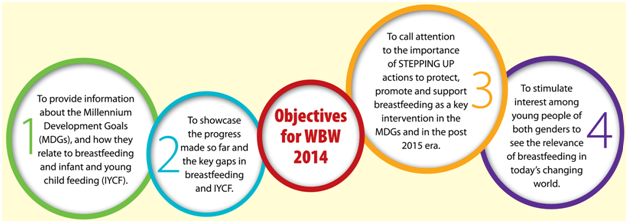
Breastfeeding Awareness Week 2014: “A Winning Goal For Life!”


August 1st 2014 marked the beginning of the 22nd annual World Breastfeeding Week (WBW), sponsored by the World Alliance for Breastfeeding Action (WABA).  The United States is one of 175 countries to participate in this yearly event which seeks to promote and encourage breastfeeding worldwide.  Groups of breastfeeding mothers and their supporters have participated in WBW events across Michigan, including Kalamazoo’s second annual event known as the Big Latch On where over 100 women publically breastfed their children in unison. Women who choose to breastfeed in public, such as those who attended the Kalamazoo event, have recently gained more protection from the state.  Mid June of this year, the Michigan Legislature passed the Breastfeeding Antidiscrimination Act, which states that women have the right to breastfeed in any public location throughout Michigan without fear of penalty or repercussion.  Demonstrations such as the Big Latch On and the recent passing of the breastfeeding bill show that Michigan’s residents have made strides toward accepting breastfeeding as a normal part of childrearing.  In fact, a recent report by The Detroit Free Press indicates that the number of infants breastfed in Michigan is increasing.    

According to the Michigan Department of Community Health and the World Health Organization (WHO) breastfeeding has a wide range of benefits:  

-Breast milk changes with your child's nutritional needs
-Breast milk protects children against certain allergies and illnesses including obesity, diabetes and pneumonia
-Breastfeeding produces no waste  
-Breastfeeding saves the family money that would be spent on formula
-Breast milk is clean
-Reducing the Mother’s risk of type 2 diabetes and certain forms of cancer
-Breastfeeding strengthens the bond between mother and child

Along with understanding the benefits of breastfeeding it is important that women who choose to breastfeed also feel their decision to do so is supported by those around them.   In honor of World Breastfeeding Week the WHO has created several informational posters about supporting a mother’s decision to breastfeed.

http://www.who.int/topics/breastfeeding/WHO_breastfeeding_graphic_series_mum.jpg?ua=1http://www.who.int/topics/breastfeeding/WHO_breastfeeding_graphic_series_dad.jpg?ua=1http://www.who.int/topics/breastfeeding/WHO_breastfeeding_graphic_series_family.jpg?ua=1http://www.who.int/topics/breastfeeding/WHO_breastfeeding_graphic_series_colleagues.jpg?ua=1


For those in the Ann Arbor area, the Lamaze Family Center of Ann Arbor hosts a number of classes designed to assist women and their partners who wish learn the breastfeeding basics and how to continuing breastfeeding through your transition back to the workplace.  If you are a Lamaze educator or would like to learn more about Lamaze International’s role in Breastfeeding Awareness Week take a look at what Lamaze’s Science and Sensibility blog has to say.  

Monday, July 14, 2014

Lamaze Ran Dexter-Ann Arbor….Thanks for Your Support!


This is the first year that the staff and board of Lamaze Family Center has run and walked in the Dexter-Ann Arbor events and we had a blast! We had team members participating in all of the events including the 5k, 10k, half marathon and kids run.

Our team also did a great job fundraising for Lamaze Family Center Ann Arbor. Altogether we had over 60 donors, and we raised about $2800.00. This money is essential is helping us to continue offering our support groups and other free services. Although most people become involved with Lamaze when they register for one of our fee-based classes, we also serve the community through our free support groups, classes, and scholarship program.

Here's an idea of how the $2800.00 helps us meet our goal of empowering, educating, and supporting new families.

$2800 will cover:
  • 6 months of costs for our Miscarriage and Newborn Loss Support Group plus
  • 6 scholarships for our childbirth education classes plus
  • 5 educational seminars in the community
Thanks so much to all of our wonderful staff, board, and donors who work so hard to help Lamaze Family Center fulfill its mission!


And here are some pictures from the weekend:


Thursday, June 12, 2014

Our Newest Class…Transitioning Back to Work!


Adjusting to parenthood is hard. New moms especially need time to recover both physically and emotionally from the birth experience. Without the kind of paid maternity leave offered in other countries, however, we see lots of moms going back to work just a few weeks after their baby is born. In our mothers groups and breastfeeding classes, we have seen an increasing demand for information about the transition back to work. To answer these request, we've created a whole new class devoted specifically to strategies for a successful transitions back to work.
Taught by a licensed social worker and board certified lactation consultant, our new class covers topics such as:

  • Choosing childcare
  • Scheduling your workweek
  • Working with your employer to ensure a smooth transition
  • Self care and couples care
  • How to continue breastfeeding while working (all your pumping questions answered!)
While we recommend taking this class after baby arrives (you'll have a better idea of the issues you need addressed), moms are also welcome to take the class before baby is born if it fits better into your schedule this way. 

Each 2 hour class will allow plenty of time for questions and answers so that the information can be personalized to your situation. You will also have the opportunity to meet other new parents facing similar challenges. Get the information you need to make a confident, successful journey back into the workplace!

We have two Transitioning to Work classes scheduled for Summer 2014. The first is on Saturday June 21st and the second is on Saturday August 23rd. Both classes are from 10am-noon. Class space is limited to ensure time for questions and interaction, so register soon!
Click here to register.

Tuesday, May 13, 2014

May is Preeclampsia Awareness Month...


May is national Preeclampsia Awareness Month. A recent survey done by the Preeclampsia Foundation found that while overall awareness of Preeclampsia is high, there is still relatively low awareness of all of the symptoms associated with Preeclampsia.
Preeclampsia and other hypertensive disorders of pregnancy remain one of the leading causes of maternal and infant death. Although preeclampsia generally affects women in the 2nd or 3rd trimester of pregnancy, preeclampsia can make its first appearance up to six weeks postpartum. For women with symptoms of preeclampsia, recognizing those symptoms and getting medical help saves lives.
The most common symptoms of preeclampsia are:

  • Swelling of the hands and face, especially around the eyes (swelling of the feet is more common in late pregnancy and probably not a sign of preeclampsia)
  • Weight gain of more than five pounds in a week
  • Headache that won’t go away, even after taking medication for pain relief
  • Changes in vision like seeing spots or flashing lights; partial or total loss of eyesight
  • Nausea or throwing up, especially suddenly, after mid pregnancy (not the morning sickness that many women experience in early pregnancy)
  • Upper right belly pain, sometimes mistaken for indigestion or the flu
  • Difficulty breathing, gasping, or panting
  • “I just don’t feel right”
It is important to remember that not everyone with these symptoms has preeclampsia, and not everyone with preeclampsia has these noticeable symptoms. Preeclampsia is only diagnosed by healthcare providers by monitoring blood pressure and protein levels in the urine during pregnancy. If you or someone you know has these symptoms during pregnancy, please let your healthcare professional know, so that you (or they) can be evaluated for preeclampsia. 

Thursday, May 1, 2014

Because of Lamaze…I Can Push Through It: Dexter-Ann Arbor Fundraiser


Each year Lamaze Family Center Ann Arbor engages in two major fundraisers to raise money for our free community programs. This year for our spring fundraiser, a number of our staff and board members are walking or running the Dexter-Ann Arbor 5k, 10k, or half marathon on June 1st. In addition, some of our kids will be participating in the kids run on May 31st. Our theme is "Because of Lamaze…I Can Push Through It."
Those who take our fee-based classes may wonder why we need to fundraise. If we ask people to pay for our classes, why do we also ask the community for donations? As a 501c3 nonprofit,  Lamaze Family Center offers a number of free classes and support groups. These include the Miscarriage and Newborn Loss Support Group, (hosting) the Postpartum Depression Support Group,  the Infant Feeding Support Group, Teen Childbirth Preparation, and free educational seminars. As part of our mission to empower and support young families, we believe that it is important to provide these services free of charge to anyone who might benefit. In addition, we also offer a scholarship program for our fee-based classes, so that everyone is able to access high quality prenatal and postnatal education.
We ask for donations because we rely on community support to keep these programs running. Some of these services, like our Miscarriage and Newborn Loss Group and Teen Childbirth Preparation Classes are the only ones of their kind in the area.
If you'd like to learn more, you can visit our team page by clicking here.  And if you are able, consider making a donation in support of our free programs. Every donation makes a difference! Thank you.